Insight · 2026 Farm Bill · USDA Section 9003
Congress Got the Blueprint Right. Now Fund the Build.
The Senate's 2026 Farm Bill gets the Section 9003 technical reforms right. It still doesn't put any money behind them.
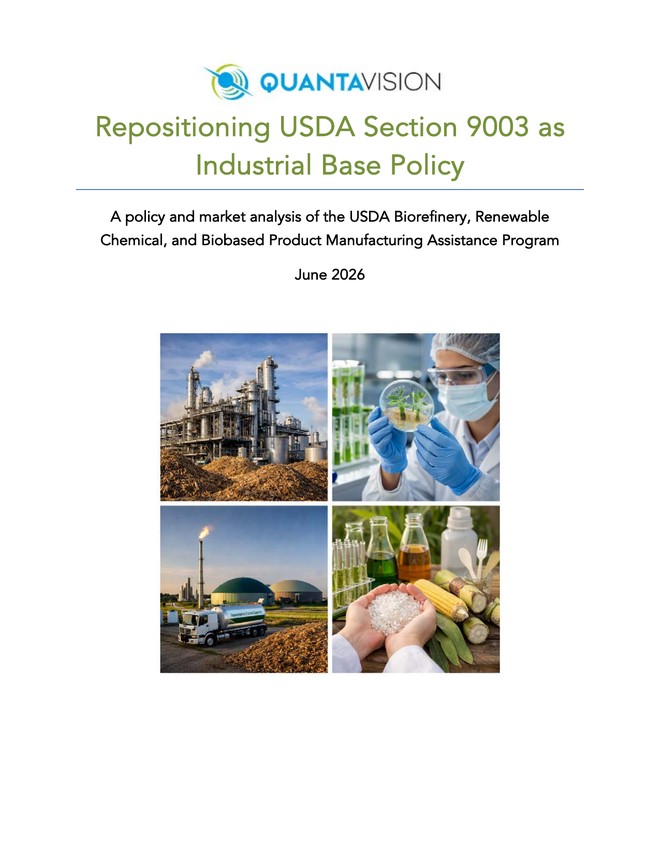 Read the White Paper →
Insight · 2026 Farm Bill · USDA Section 9003
The Senate's 2026 Farm Bill gets the Section 9003 technical reforms right. It still doesn't put any money behind them.
Read the White Paper →
Congress got the technical reforms to Section 9003 right. It just forgot to fund them.
I have been working with Section 9003 since it was written into the 2008 Farm Bill — not as a policy observer, but as someone who has sat with developers at the application table, worked alongside lenders trying to underwrite these projects, and watched technologies with real commercial promise stall for reasons that had nothing to do with the program itself. So when the Senate Agriculture Committee released its 2026 Farm Bill, I read the Section 9003 provisions with more than passing interest.
What I found was genuinely encouraging. The technical and regulatory reforms included in the bill — multi-year authority so developers can plan against a real pipeline, a two-track diligence process that stops treating proven technology like first-of-a-kind risk, clearer stage gates, and streamlined intake mechanics — are exactly the changes practitioners and lenders have advocated for. These are changes I and many others have recommended for years. The bipartisan support behind them is meaningful, and Congress deserves genuine credit for getting the architecture right.
Here is the question I keep hearing from developers, lenders, and project sponsors: given the reforms, should we engage?
My honest answer is that the path to financial close just got clearer on paper, but it still doesn’t have money at the end of it. Why should an applicant invest the development capital — engineering, diligence, integrated demonstration work — that moving through Section 9003 actually requires, if there’s no credible path to funding the commercial plant on the other end? That capital is the riskiest, hardest money in the entire project stack. Being in the program does not make it appear. It never has. And right now, the program offers a cleaner map to a destination that’s still not funded.
The new Farm Bill language does include one other provision worth understanding. USDA would be authorized to award grants of up to $10 million for the construction of integrated demonstration units and a four-month commercial demonstration test. For anyone who has tried to raise the at-risk development capital that this kind of testing requires, that authorization matters — it is genuinely difficult money to assemble, and a grant program that covers it would meaningfully improve a project’s ability to reach the point where loan guarantee financing becomes viable. The problem is that the Senate has not appropriated funds for this grant program either. The authority exists on paper. The capital does not.
There is recent history that puts the funding gap in sharper relief. The Biden administration opened a similar integrated demonstration program using $200 million in Commodity Credit Corporation funds. Approximately twenty companies had applied when the Trump administration cancelled it. Those twenty companies represented approximately $3 billion in anticipated commercial manufacturing costs — projects that were positioned to move forward through Section 9003 loan guarantees once demonstration milestones were met. At a 30% loan reserve rate, covering that pipeline would have required approximately $1 billion in reserve authority. It is a concrete illustration of what a funded program can attract and what it loses when funding disappears.
Against that backdrop, the Senate’s current Farm Bill draft takes another $12 million out of the existing Section 9003 reserve program, which currently stands at $144 million. The good will reflected in the technical reforms and the hard math of the funding picture are not in sync, and I have not yet found a satisfactory way to explain that combination to a developer who is trying to decide whether to engage. That is the specific gap the conference process needs to close.
That matters more this year than it has in a long time, because of what else the Farm Bill package includes.
The same legislation points to $15 billion for biotech research and development to counter China’s dominance in biotechnology. That instinct is right, but it is aimed at the wrong end of the problem.
China did not beat us at science — we produce extraordinary science — but China beat us at scale-up, at converting domestic innovation into domestic manufacturing, and domestic manufacturing into supply-chain leverage. The National Security Commission on Emerging Biotechnology was unambiguous about this: biotechnology is no longer a niche scientific field, it is becoming a general-purpose manufacturing platform, and the U.S. is at risk of losing the industrial base that makes the difference between inventing something and owning it. The Commission’s call for $15 billion was not a call for more research grants. It was a call for the kind of deployment capital that turns American innovation into American production capacity.
The Chinese government funds both ends of that pipeline. State-designed financing architecture moves technology from lab to commercial plant with speed and intentionality. What China has built is not primarily a research advantage — it is a commercialization advantage, backed by capital that specifically targets the first-of-a-kind facilities that prove a technology works at industrial scale, generate a return, and create the template for the second and third build.
Section 9003 is one of the few U.S. programs designed to operate at exactly that point. Without new funding, the $15 billion aimed at offsetting China doesn’t close the gap it was meant to close. It funds the science, but it does not fund the plant. And when we invent something here and build it somewhere else, we do not simply lose a market opportunity — we lose the supply chain, the skilled workforce, the operational know-how, and the export leverage. That is the loss that matters, and it is the loss that $15 billion in research spending, without first-of-a-kind commercial financing, does not prevent.
The economic case for what Section 9003 can do is direct and measurable. Agricultural producers are squeezed — thin margins, and capital that costs more to borrow than it has in years. Rural communities are competing hard for the kind of industrial investment that brings skilled, year-round employment and a durable tax base. Section 9003-backed facilities create markets for agricultural and forestry inputs that otherwise carry minimal value, anchor clusters of local service businesses — trucking, fabrication, maintenance, environmental compliance, utility interconnections — and generate skilled operating jobs that keep farm families in rural communities. They strengthen both sides of the farm balance sheet: new revenue streams and reduced exposure to delivered-price volatility for inputs like fertilizer and fuel.
As Michael Keller argues compellingly in “Rural America Doesn’t Need More Extraction — It Needs Builders” (LinkedIn, June 19, 2026), the distinction that matters for rural economies is not whether investment flows in — it is whether value-added manufacturing gets built there. That distinction is the difference between a rural county that captures a generation of industrial employment and one that exports its raw materials and watches the jobs appear somewhere else. Section 9003 is a tool for the first outcome. Starved of capital, it produces the second.
Congress answered the technical question about how Section 9003 should work, and that answer is good. The question it still owes developers, lenders, rural communities, and the farm families who would supply these facilities is the financial one: is the program going to be funded at a level that makes application a rational act?
I have spent a long time making the case that this program works — that the failures people attribute to it usually originate somewhere upstream, and that the path to financial close is navigable for sponsors who map it carefully. That argument gets harder to sustain when the program has no capital behind it. Congress has done the difficult work of building the right framework. My hope is that it finishes the job by funding it.
The Full Case
The complete analysis — the market data, the policy argument, and the specific reforms Section 9003 needs in the 2026 Farm Bill to function as the deployment engine for America’s biotech industrial base.
Before you submit Part One, benchmark yourself against the nine constraints that decide whether a first commercial project gets financed and built. A free 27-question self-assessment — about fifteen minutes.

Founder and CEO of QuantaVision, a firm that since 1994 has helped innovators in renewable fuels, renewable chemicals, biobased products, and value-added agriculture finance and commercialize breakthrough technologies. She has worked inside the USDA Section 9003 program since its creation in the 2008 Farm Bill and is one of its most active practitioners, guiding developers through the full path from concept to financial close. Her white paper, Section 9003: Industrial Base Policy and the Path to Commercial Scale, is available at quantavision.earth. Connect on LinkedIn or at quantavision.earth.
For more information: “Rural America Doesn’t Need More Extraction — It Needs Builders,” Michael Keller, LinkedIn, June 19, 2026.